
Balanced Widgets Launch with SODAX Leveraged Staking Vaults
Balanced, has shipped its long-awaited Home page and widget catalogue: a customizable dashboard where users add, resize, and arrange only the DeFi tools they actually use. Their Vault widget now runs three leveraged liquid staking strategies, funded by a deposit of any asset from any supported network.
SODAX Team
•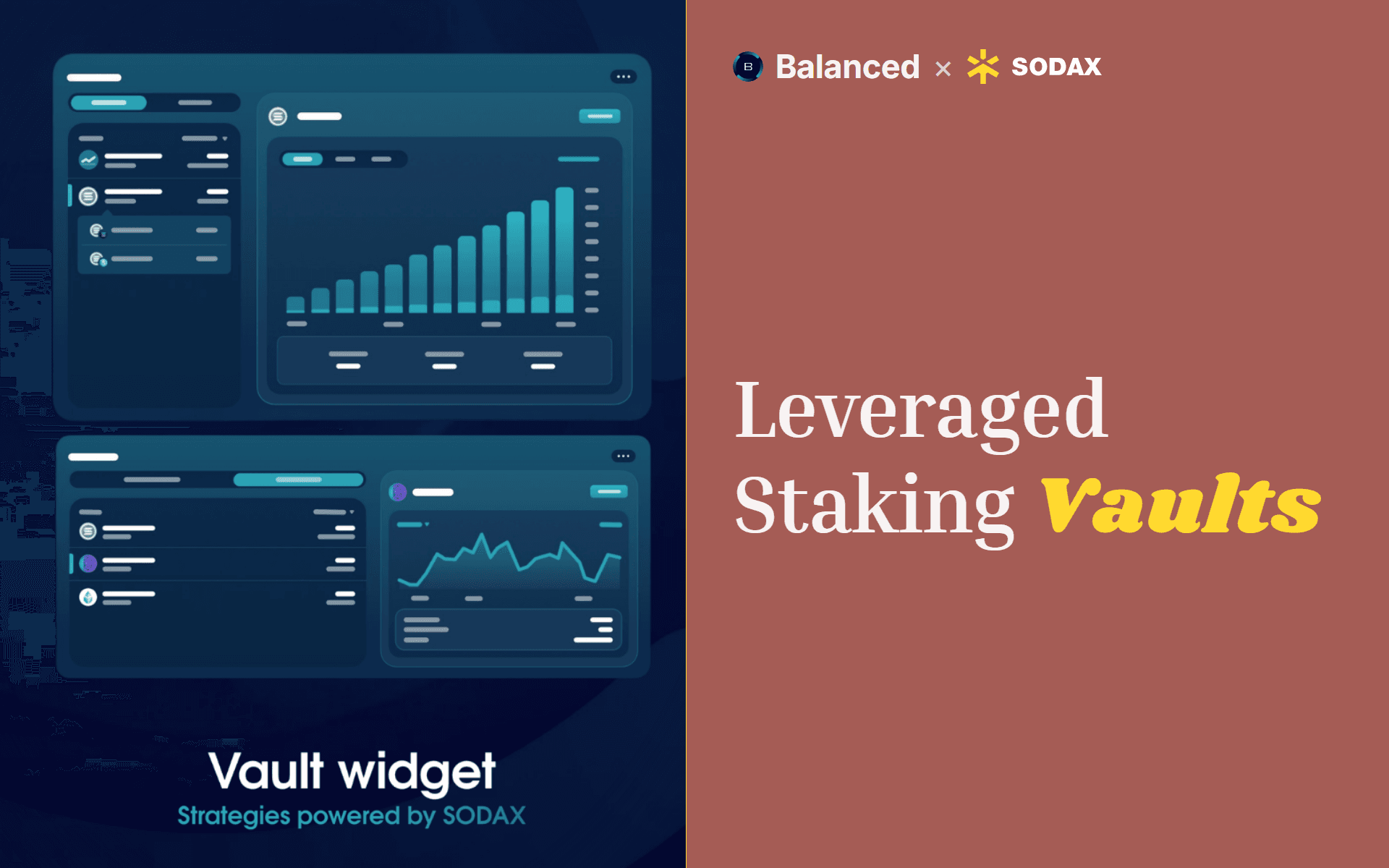
Balanced, has shipped its long-awaited Home page and widget catalogue: a customizable dashboard where users add, resize, and arrange only the DeFi tools they actually use.
Their Vault widget now runs three leveraged liquid staking strategies (JitoSOL, weETH, and wstETH), funded by a deposit of any asset from any supported network.
Users can now access Leveraged liquid staking to loop a staked asset against itself and compound yield.
A Home Page Built Around What You Actually Use
Getting anything done in DeFi usually means juggling apps: one to trade, one to check prices, one to manage a lending position, each with its own user interface to navigate. Balanced set out to fix that.
Balanced have always approached DeFi’s user experience problem head on, taking a design-first approach against the cluttered and protocol centric standard in the space. Today’s widget release puts that focus squarely on the person using the app. Having already shipped a new version of their application and tripled the assets available to trade this year, Balanced have cleared the ground for an even bigger idea: one home page built around whatever tools a user actually needs.
That home page and widget catalogue are live now. Open app.balanced.network, click Add Widget, and drop in what you need. Resize it, move it, group widgets into spaces for different tasks. Connect a wallet and the layout even follows you across devices.
Two widgets ship in this first release: a Price Chart widget to follow your favorite assets, and a Vault widget to access leveraged staking yield through the SODAX execution system.
LST Vaults with SODAX
Balanced already runs its exchanges and its money market lending and borrowing on SODAX, coordinating activity across 20+ blockchain networks so builders don't have to manage that infrastructure themselves. The Vault widget extends that into a third feature, available through SODAX’s API and SDK toolkit: leveraged liquid staking.
Stake ETH or SOL and you typically get a liquid staking token, or LST, back: a token that represents the staked position but stays usable elsewhere in DeFi. wstETH, weETH, and JitoSOL are all LSTs, and the Vault widget runs leveraged strategies on all three.
The strategy is called looping and behind the scenes, the following happens. An asset is used to acquire and stake a base asset and receive its LST. This LST is then supplied to SODAX's money market as collateral to borrow the unstaked version against it. The process is then repeated to create these “looped” positions, with each loop adding a bit more staking yield and borrowing cost on the new debt. Because the staked and unstaked versions track the same price, it's a relatively contained form of leverage. Beware however that if a staked asset does depeg from the base asset it tracks, positions may face liquidation.
The beauty of Balanced’s release is that these steps of looping and unwinding don’t need to be managed manually by the user. Through the Vault Widget, a user can simply deposit into the strategy from any asset across supported networks and withdraw with the same ease.
More to come
The Price Chart widget rounds out this release with much more to come on Balanced's roadmap, that you can find in their announcement blog. The widget catalogue is now live at app.balanced.network for you to try out.
If you want to learn more about the execution behind the Vault widget, the other cross-network features on Balanced, or to enquire about building with SODAX yourself, please head to sodax.com.